
What to Put in a Care Package for a Friend Who Is Grieving
What to pack, when to send it, and what to write on the card — drawn from real sympathy orders, with the timing most gift guides miss.
The short answer
Build a care package for a grieving friend around comfort that asks nothing of them: something soft to wrap up in, drinks and food that need no cooking, tissues, something warm to hold, and a handwritten note that expects no reply. Skip perishable meals, strong scents, and anything to wash or return. Send it two to four weeks after the loss, once the calls have gone quiet.
What to put in a care package for a grieving friend
Everything inside the box should work without any effort from the person opening it — no cooking, no cleanup, no decisions, no reply owed. Grief leaves very little energy for ordinary life, and a gift that needs assembling or answering quietly becomes one more task on a list that is already too long. Comfort that simply happens is the whole brief.
-
Something soft to wrap up in
A throw or blanket to disappear into on the sofa.
-
Drink and food that skip the stove
Herbal tea or cocoa, and shelf-stable snacks that open one-handed.
-
The things that run out first
Tissues and the small everyday comforts that vanish within a week.
-
Something to hold
A warm mug or a candle — hands need somewhere to go.
-
A handwritten note
A few honest lines that ask for nothing back.
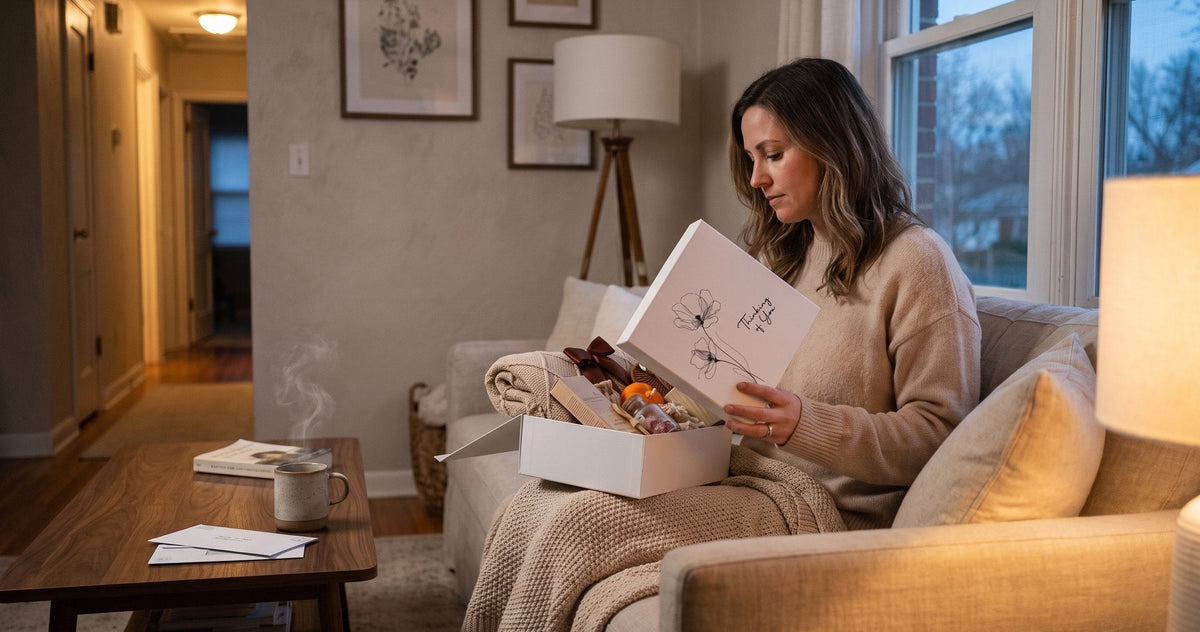
That is the shape our sympathy gift boxes take: a 50×70 throw, tea or cocoa, a hand-poured candle, a ceramic mug, a small bouquet of dried flowers, and a card — with your friend's name printed on the lid, so the box is unmistakably theirs before it even opens.
A box like this fixes nothing, and it is not trying to. It says I'm here at the exact moment when words are hardest to find, and it keeps saying it every evening the blanket comes off the back of the couch.
When to send it — and why a month later often lands harder
The first two weeks after a loss are strangely crowded. There is a funeral to arrange, relatives in the kitchen, food on every shelf of the fridge, the phone ringing all day. Then, somewhere around week three, all of it stops at once — the visitors leave, the casseroles are gone, and the house goes quiet.
Etiquette guides put the ideal window for a home delivery at two to four weeks after the loss, precisely because of that quiet. A box that arrives after the crowd has gone says something no early gesture can: you are still thinking of them, now that thinking of them is no longer the obvious thing to do.
Most of the gifts we write about in the Journal forgive loose timing — a birthday box can run a day late and still delight. This one rewards patience instead. The gap everyone dreads filling is not the week of the funeral; it is the long stretch after.
So if a month has passed, or three, send it anyway. The silence hurts more than a late box ever could. Just let your friend know something is on the way, so the delivery doesn't catch them off guard — orders ship within 1–2 business days, and most arrive 5 to 9 business days after checkout.
What to write on the card
Our order notes tell a clear story about what people actually write. For every card that opens with a formal "deepest sympathy," roughly five arrive with a plain "sending hugs" or "thinking of you." The simple word wins over the solemn one, again and again. And people almost always write something — a blank card is a rarity in these orders.
The notes themselves are less polished and more honest than anything in a greeting-card aisle:
"There are no perfect words for what you're walking through — just know that you are surrounded by people who are holding you, even on the days you can't feel it."
Some are a single line: "Grief is just a reminder of the love that will always be there." Others are a quiet offer of presence: "I am always here with an ear to listen, a shoulder to lean on, or just a quiet smile."
Whatever you write, add one sentence that releases your friend from replying — as plain as "there is absolutely no need to respond, text, or write a thank-you card." It lifts the last obligation a gift can carry: the duty to be polite about it.
Swap the vague "let me know if you need anything" for a concrete offer with a task and a day attached — groceries on the porch Thursday, the dog walked Tuesday afternoon. A specific offer can be accepted with one word; a vague one hands the tired person another decision.
Leave out any phrase that tells your friend how to feel. "Be strong," "stay busy," "they're in a better place" — each one quietly sets a schedule for something that doesn't keep one.

What not to put in the box
Perishable food and home-cooked meals top the list. The fridge is already crowded with well-meant dishes, and an expiry date turns a kindness into a deadline.
Anything that must be washed and returned comes next — casserole dishes, tins, containers. However generous the contents, a returnable container is a gift with a debt inside, and your friend will feel it sitting on the counter.
Strong fragrance deserves real caution. One four-star review of a box like this named the scent as the thing that didn't land: "The only thing I would say I didn't care for was the smell of the little bouquet of flowers." Smell is too personal a thing to choose for someone else — mild or neutral is the safer road.
Craft kits, guided journals with assignments, dense books: everything that looks like an unfinished task will sit on the nightstand and radiate quiet guilt. The same goes for keepsakes stamped with ready-made phrases like "an angel got their wings" — unless those are words you and your friend already share, they belong to someone else's grief.
Even the packaging carries the message. A box that opens in one motion beats a basket sealed in shrink-wrap and ribbon; untangling decoration is effort, and effort is the one thing this gift promised not to ask for.
Sending one from a group or an office
A card signed by a team, a department or a whole office is completely normal — in our orders, collective notes appear all the time, sometimes signed simply as someone's "work family." If you are the one organizing, you are not improvising an awkward workaround; you are doing what many people quietly do.
"We are so sorry for your loss. We hope this small gesture brings a bit of comfort and serves as a reminder that you are supported and cared for by your work family."
The tone that works is warm and short — sympathy without office formality, and a signature clear enough that your colleague knows who it is from, with no titles attached and no reply expected.
What the organizer actually decides is practical: one box to the home or several to different addresses, what the lid should say — "Sending Warm Hugs" is the inscription our customers ask for most — and who signs the card. Shipping is a flat $11.99 per address across all 50 states, and bulk pricing starts at 5 boxes if the group wants to send more than one.

The second box: anniversaries, birthdays and the first holidays
Some dates bring the loss back with full force: the anniversary, the birthday of the person who died, the first Christmas without them. They arrive months later, exactly when everyone around your friend has returned to normal life — which is what makes a small package on one of those days land so deeply.
A second box is built differently. The first helps someone get through a week; the second helps them remember — a candle to light on the day, a soft blank notebook, something small enough to keep. And in the note, use the name of the person they lost. Months on, hearing that name spoken is what grieving people quietly wait for and almost never get.
If the first holiday season is what worries you, we've written separately about Christmas gifts for someone who is grieving — what helps, and what to skip, when the calendar insists on being merry.
Questions people ask
Is it too late to send a care package a month after the loss?
No. Two to four weeks after the loss is the usual window, and a box that arrives a month or two later often means more, because by then the calls and visits have stopped. Our sympathy orders go out in every month of the year — there is no deadline on this kind of gift.
What do you write when you don't know what to say?
A short note is more honest than a long one. Admit that words fall short, use the name of the person who died, and free your friend from replying. One real card put it simply: "I wish I could be there to give you the biggest hug you deserve in this hard time… I hope you enjoy this box until I can come down and give you the real hug you deserve."
Can you send a care package to a coworker or someone you don't know well?
Yes. A noticeable share of the cards in our orders are signed collectively — by a team, a department or a whole office. Keep the tone warm and brief, and sign it so your colleague knows exactly who it is from, with no reply expected.
How long does a sympathy gift box take to arrive?
Orders ship within 1–2 business days, including personalized boxes, and most arrive 5 to 9 business days after checkout. Shipping is a flat $11.99 per address, anywhere in the 50 states. A quick heads-up to your friend means the delivery won't catch them off guard.
From this guide
The boxes we'd send.
Each of these follows the five-thing rule.

Dried Bloom & Cocoa Blanket Box
$62.00
Cotton Scrubber Soak & Cocoa Box
$61.00
Pumpkin Cookie & Honey Mug Box
$66.00Keep reading
 ChristmasOccasions
Christmas Gifts for Your Boss: Why the Team Gift Works
A gift from one employee to the boss isn't expected, but a gift from the team is. How to pool, choose and... OccasionsThanksgiving
Thanksgiving Host Gifts: What to Send Before or After Dinner
A host gift thanks the table without adding to the day's work. What to send, when to order for dinner on November... ChristmasOccasions
When to Order Christmas Gifts So They Arrive in Time
Order by Friday, December 11, 2026 and even the slow end of our 5 to 9 business day window lands before Christmas....The newsletter
The next occasion is already on the calendar.
One email a month — a guide, an idea, and the shipping dates that matter.