
Housewarming and New Home Gift Ideas: A Complete Guide
What to give someone who just moved, what to spend, when to send it, what to write on the card, and what to leave out, with notes from our order records.
The short answer
A housewarming gift says congratulations to someone who is still finding the light switches. The ones that land get used up and disappear: good tea or coffee, chocolate, a hand-poured candle, a soft throw, a mug that quietly becomes theirs. Most people spend $30 to $100 depending on how close they are, and send it within the first weeks after the move.
What do you give for a housewarming?
Nobody who has just moved needs another object. They need a way to hear "congratulations" that arrives on time and asks nothing of them: no box to find a place for, no vase that competes with the one already unpacked. That is what you are choosing, and it is why the gifts that work are mostly things that get used.
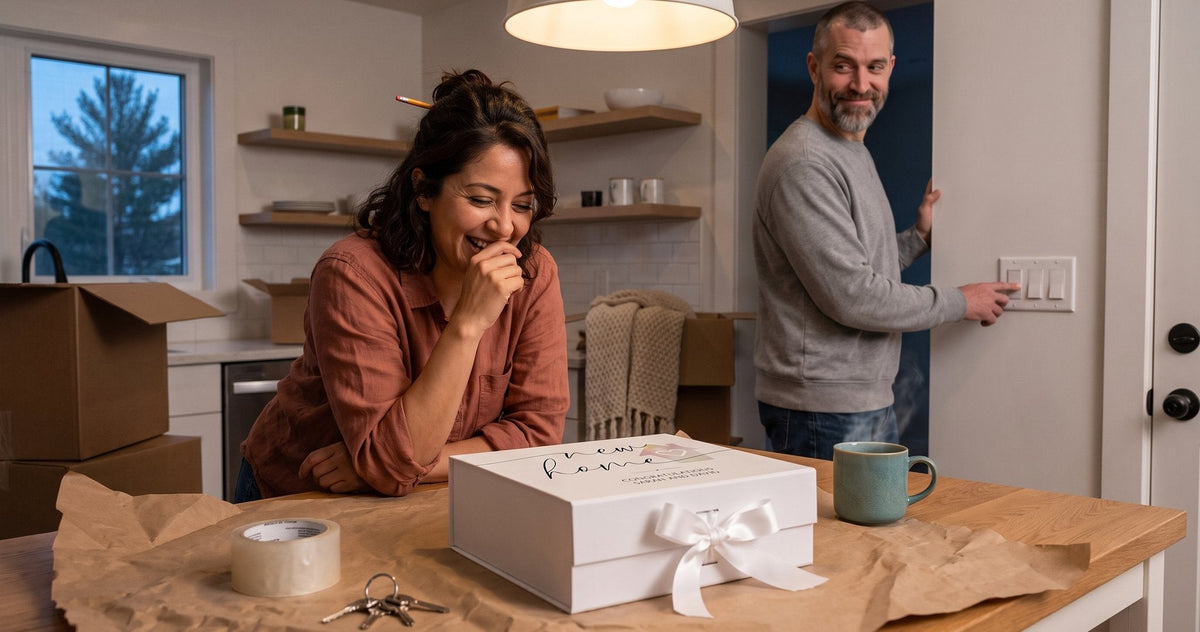
Picture the box open on a counter still covered in packing paper. A 50×70 throw folded on top. A hand-poured candle. A ceramic mug, or two. Tea or coffee, a bar of chocolate, honey with a small wooden dipper. Each is finished the moment it is used, and none needs the new owner to decide where it lives. The same logic runs through the rest of the Nikimoon Journal, but a new home is where it matters most.
The contents of our boxes are hand-picked from small makers and thoughtfully assembled around one moment. The box itself, the magnetic lid with the recipient's name, and the card chosen for the occasion are designed in-house and packed by hand in our studio. We choose the candle; we do not pour it. We print the name; we do not weave the throw. Keeping those facts apart is the honest version of "personalized."
Most people spend $30 to $100 on a housewarming gift, more for close family, and send it in the first weeks after the move. Our boxes ship within 1–2 business days and most arrive 5 to 9 business days after checkout, so an order placed about two weeks before the date lands with room to spare.
Who is a housewarming gift actually for?
Before you choose anything, name the relationship. The gift for your sister's first house is not the gift for the neighbors who invited you over, and neither is the gift a lender sends on closing day. Closeness sets the amount, the form, and the moment it should arrive.
A close friend or a sibling gets the box that feels like a night in: throw, tea, something sweet. Neighbors who invited you over get something you can hand across the doorstep. Family three states away gets a box that ships, with a card that carries most of the message. A coworker gets something warm but light. The agent or loan officer who handled the sale is giving on different terms altogether.
Our own order records make that last group smaller than the search results suggest. The notes people ask us to print on housewarming boxes come overwhelmingly from friends and family; roughly one in seven is written from the professional side of a sale, by an agent, a mortgage specialist, or a lending team. The occasion sounds "realtor" far more often than it is. If you are giving because you closed the sale, the rules differ enough to get their own section below.
Consider, too, who is opening the box. The National Association of Realtors reported in 2025 that the median first-time buyer in the United States is now 40 years old, and that first-time buyers make up about a fifth of the market. The "young couple in their first place" list most gift guides are built around is written for someone who, more and more, is not the person receiving the keys. Choose for the person, not the template.
What goes inside a housewarming gift box?
In a home where nothing has found its place yet, the gifts that fit are the ones that get used or held. Food, drink, light, and warmth do not ask the owner to decide where they go. A lamp, a framed print, a second vase decide for them, and the deciding is the burden. That principle does more work than any checklist.
Shoppers say the same thing when asked. In 2026 kitchen items are still the housewarming category people most want to receive, named by more than half of those surveyed; organization and décor sit lower, and cleaning supplies lower still and slipping year over year. The same research found a specific, physical gift now preferred over a gift card by a wide margin, wider than the year before. A jar of honey says you thought about their kitchen.
Our New Home collection is built on the same idea, and the boxes differ by situation rather than by price. The New Home Warmth Box holds a 50×70 throw, two ceramic mugs, and tea for two; it is the box for a couple's first night, when the bed is made and nothing else is. The New Home Sweet Gathering Box pairs a wooden serving board with two mugs, honey, and a chocolate bar, for people who will have friends over before the pictures are hung. The Old Fashioned Toast Box carries a handmade glass, two Old Fashioned cocktail mixes, and pistachios, for when a toast is called for and the bottle should be the owner's choice. No alcohol ships in it; the glass and the mixes are the gift.
Item-by-item lists live elsewhere. If you are packing a box yourself, the guide to what to put in a housewarming gift box goes piece by piece, and its companion on what to put in a housewarming gift basket covers the open-basket version.

How much do you spend on a housewarming gift?
Coworkers and neighbors usually land between $20 and $50. Close friends and siblings, $50 to $100. Immediate family, $100 to $200. A group gift from a whole friend circle or an office starts around $200. The Emily Post Institute keeps its baseline at $30 to $50.
The top of the range does not buy more warmth. Hallmark's research found that a handwritten note raises the perceived value of a gift by about a quarter, 27 percent in their count. Deloitte found that three in four consumers call a personalized gift more meaningful than a generic one, and Shopify's data shows personalized gifts come back about half as often. The name on the lid does more than the price on the tag.
With a Nikimoon box, the personalization is part of the box, not a line item: the recipient's name is printed on the magnetic lid, and the card is chosen for the occasion. Shipping is flat $11.99 per destination, to all 50 states. Spend where the relationship puts you, and let the note carry the rest.
When do you send a housewarming gift?
Bring it to the party if there is one. Ship it if you cannot be there. Send it for the day of the keys if you are the person who handed them over.
The party runs later than most givers assume. Etiquette writers agree that a housewarming is usually held several weeks to a few months after the move, once there is, in Lizzie Post's phrase, "a place to sit," and many happen half a year in. So it is hard to be late. With no party on the calendar, the first weeks after the move carry the most feeling, and a month or two later is still welcome.
Our own timing is fixed: boxes ship within 1–2 business days, personalized ones included, and most arrive 5 to 9 business days after checkout. Ordering about two weeks before the date you have in mind covers the party, the closing, and the first Thanksgiving in the new kitchen.
| The situation | What goes in the box | When to order |
|---|---|---|
| A housewarming with a date on the invitation | Food to share: a serving board, mugs, honey, chocolate | About 2 weeks before the party |
| A move with no party planned | Warmth and quiet: a throw, a candle, tea | In the first weeks after the move |
| Closing day, from whoever handled the sale | A throw and mugs for two, something to toast with | About 2 weeks before closing |
| The first holiday in the new home | Tea, cocoa, a candle, a throw | About 2 weeks before the holiday |
| A move to another state | Any shipped box, with the card doing more of the work | As soon as you have the new address |

What do you write on a housewarming card?
The card people choose for a housewarming box is usually a congratulation: close to two in three in our order records, with a thank-you a distant second. When the card is blank in front of you, start with the event, said in your own words.
What people wish for is the other thing our records show. Roughly one in four notes says nothing about furniture or paint and speaks instead about what will happen inside the house: memories, moments, laughter, a table with people around it. "Wishing you many happy moments and wonderful memories in your new space." Even a note as short as "A little something for your new home" treats the home as a place where a life happens, not a set of rooms.
Congrats on your new home. We hope that this space brings you peace, love and joy.
- Name the event in your own words. "Congratulations on the house on Maple" lands harder than "Congratulations."
- Make the wish specific: a first dinner, a quiet Sunday, rather than a line that fits any card.
- Sign it the way they know you: a nickname, the way you end your texts.
If you cannot be there, the note does half of the gift's work. A box that arrives in another state with a name on the lid and nothing inside the card is a delivery. The same box with three lines about the first time you'll visit is you standing in the doorway.
What not to give a new homeowner
Some of the old rules are still kept, and it costs nothing to respect them. Knives and scissors are said to cut the friendship; the old workaround is to tape a coin to the blade so the recipient can hand it back and "buy" the gift. Clocks are an uneasy present in many families, and in Chinese the phrase for giving a clock, song zhong, sounds the same as the phrase for attending a funeral. A wallet or piggy bank is never given empty; a coin goes inside first.
Practical concerns stack on top of the folklore. A heavily scented candle can set off allergies and migraines, and a plain white unscented one reads as funerary in Chinese and several other Asian traditions. White chrysanthemums and lilies carry the same meaning across much of East Asia. Lizzie Post of the Emily Post Institute warns against reaching for a bottle or a houseplant by default: you rarely know someone's relationship with alcohol, their health, or their faith, and a plant arrives with care instructions, allergies, and a pet that may chew it.
The larger argument is against adding anything to the house at all. When Realtor.com and Censuswide surveyed recent registry creators in 2023, most of them newlyweds, nearly nine in ten admitted to listing things they didn't want, and about a third registered for gifts they planned to return for the cash. If people fill their own lists out of duty, an object chosen by someone else is a longer shot still. The first year is expensive on its own; a Harris Poll found that close to half of new owners face an unplanned repair within twelve months. A gift that gets eaten, poured, lit, or wrapped around someone on the couch is not the modest option. It is the considerate one.
Where housewarming traditions come from
The word is literal. Before central heating, guests to a new house brought firewood and lit every hearth in the place, and the home was warmed in the plainest sense. In France a housewarming is still called pendaison de crémaillère, the hanging of the pot hook over the fire.
The bread, salt, wine, and candle that people still carry over a threshold each came with a wish attached. Bread so the house never knows hunger. Salt for purity and hospitality. Wine for joy, or honey in Jewish homes, where the sweetness stands in for the bottle. A candle so there is always light. A new broom, in some families, to sweep out whatever the last house left behind. American audiences learned the set from the 1946 film "It's a Wonderful Life," where the blessing is spoken aloud over a family's first house.
The same set is still sold, only better dressed. The salt is pink Himalayan now, the bread is a sourdough starter, and the broom is a handmade straw one meant to hang on a hook rather than touch a floor. The custom is intact; the shelf it sits on has changed. It also explains why food, drink, and light stay at the center of this occasion while nearly every other gift category has drifted toward objects: they were the original gift.
Other homes keep other versions. Jewish tradition most often brings bread, salt, and honey. A Hindu household marks a move with Griha Pravesh, a ceremony that welcomes the family in before the house is lived in. Chinese custom avoids black and white, the colors of mourning, and reaches for red.

If you're the one who handed over the keys
Agents, loan officers, and closing attorneys give on different terms, and their share of the housewarming boxes we send has already come up: smaller than the search results imply, but real. The rule that matters most for that group is simple. A gift that carries your logo and your face reads as advertising, not as thanks. The client wanted a home; the doormat with your phone number reminds them they bought one through you.
Everything here about what fits an unpacked house applies to a client as it applies to a sister: something to eat, something warm, and a card that names the house rather than the brokerage.
Questions people ask
Is a housewarming gift required?
No. Lizzie Post of the Emily Post Institute called a housewarming gift "completely optional" in February 2026, and Miss Manners has long held that it is "properly incidental and absolutely not required." In practice most guests still arrive with something small, and that gap between rulebook and doorstep is real. Empty hands break no rule; a small edible gift settles the question.
How much should you spend on a housewarming gift?
Coworkers and neighbors, $20 to $50. Close friends and siblings, $50 to $100. Immediate family, $100 to $200. A group gift starts around $200. The Emily Post Institute keeps its baseline at $30 to $50. A handwritten note raises a gift's perceived value by about a quarter, according to Hallmark's research, so the amount is not your only lever.
When should you send a housewarming gift if you can't be there?
The first weeks after the move carry the most feeling, and a month or two later is still welcome. Parties are often held half a year in, so being late is hard. Our boxes ship within 1–2 business days and most arrive 5 to 9 business days after checkout, so order about two weeks before the date you have in mind.
What should you not give as a housewarming gift?
Knives and scissors, said to cut the friendship. Clocks, and an empty wallet or piggy bank. Heavily scented candles, because of allergies and migraines. White chrysanthemums and lilies, mourning flowers across much of East Asia. Lizzie Post also advises against alcohol and houseplants as default gifts: you rarely know the recipient's relationship with drink, their health, their faith, or their pets.
Can you send a housewarming gift box to another state?
Yes. Nikimoon ships only within the United States, to all 50 states, for flat $11.99 per destination. Orders ship within 1–2 business days, personalized boxes included, and most arrive 5 to 9 business days after checkout. The recipient's name is printed on the magnetic lid, and the greeting card is chosen for the occasion.
From this guide
The boxes we'd send.
Each of these follows the five-thing rule.


Keep reading
 CorporateGift Guides
Corporate Gift Boxes for Employees: A Buyer's Guide
What corporate gift boxes for employees cost, how a 100-box order runs from first email to last delivery, and what the IRS... Gift GuidesSympathy
Care Package Ideas: What to Send When Life Is Hard
What to put in a care package, when to send it and what to write on the card, drawn from fifteen months... BirthdayGift Guides
7 Thank You Gift Box Ideas That Feel Personal
Seven thank-you gift boxes matched to real scenes from our orders, what people actually write on the card, when to send it,...The newsletter
The next occasion is already on the calendar.
One email a month — a guide, an idea, and the shipping dates that matter.