
Long Distance Christmas Care Package: What to Send and When
When to ship a Christmas care package so it lands by December 24, what survives a cross-country truck, and what to write on the card.
The short answer
Pack what rides well in a truck — a soft blanket, a ceramic mug, cocoa or holiday tea, a candle, a card in your own handwriting — and skip anything that leaks, melts, or needs a battery. Then count backward: boxes ship within 1–2 business days and arrive 5 to 9 after checkout, so order about two weeks ahead.
Work backward from the day it lands
Count backward from the day the box should be at their door, not forward from the day you finally order. Christmas 2026 falls on a Friday, which makes Thursday, December 24 the last realistic arrival day — USPS, UPS, and FedEx are all closed on the 25th.
Our timing is plain: boxes ship within 1–2 business days, personalization included, and most orders arrive 5 to 9 business days after checkout — so the ordering window opens about two weeks ahead of the date you need.
Published carrier deadlines deserve less trust than they get. Ground cutoffs cluster in mid-December, roughly December 13–17 depending on the lane; express stretches to December 22–23. Freight professionals add 7 to 10 days on top, because the system slows after Thanksgiving and peaks the week of December 15. Alaska and Hawaii are the same 50 states, but ground transit there runs three to four days longer.
A box that misses the window doesn't arrive a little late — it sits in the backlog of an overloaded distribution center and arrives in January. "I'll send it Christmas week" is not a plan; it's a lottery ticket. The same math runs through every guide in our Journal.
What survives the truck
A cross-country box spends up to nine days getting lifted, dropped, chilled, and warmed again, so the rule is blunt: nothing that leaks, melts, or needs a battery. Water-based liquids freeze, expand, and split open in transit; home-baked cookies don't make it without vacuum sealing; a battery left in a device can switch on from the jostling and trigger a security hold, so take it out and pack it beside the device in its factory packaging.
Scent travels, too: a fragrant soap packed against food spends a week in a heated trailer seasoning everything nearby, until the cookies and tea arrive tasting faintly of the soap. Bag anything scented.
-
A soft blanket
No moving parts, no temperature limits, no way to break — and it stays warm after the phone call ends.
-
A ceramic mug
Wrapped snug, ceramic rides fine — and a mug turns the box into a nightly ritual, not a one-time unwrapping.
-
Cocoa, holiday tea, cinnamon sticks
Sealed and dry, they shrug off cold and rough handling, and they're consumable — which matters in a dorm.
-
A cinnamon-and-orange candle
The scent of the season, and the piece that does the memory work. Keep it bagged, away from anything edible.
-
The keepers
Chocolate, warm socks, a wooden nutcracker, a tree ornament — the ornament comes back out every year, long after the cocoa is gone.
That list is, not by accident, what our winter boxes are built from. The shell matters too: a new double-walled box, never a worn or store-branded one that advertises what's inside. Decorate the inside flaps — outer gift wrap tears and jams sorting machines — and pack every void tight.

Build the box around one evening
The steadiest care-package guides — written for parents of college students — rest on a proportion, not a shopping list: mostly favorite treats, one practical thing, one thing for warmth, always a handwritten note.
A cozy evening in is what leaves our studio most often: blanket, mug, cocoa or holiday tea, a candle. The most-shipped Christmas listing in our catalog is built on exactly that blanket-and-mug pair, by a wide margin: people are sending an evening, not objects.
A movie night travels almost as well: something sweet, two matching mugs, one blanket big enough to share, and an ornament — the piece that stays when the sweets are gone. If they've just moved, that ornament starts a collection; there's a separate guide to Christmas gifts for new homeowners.
A countdown box opens slowly on purpose: small things labeled by day, so it lasts a week instead of a minute. Include one thing that can be held up to a camera — researchers watching family video calls noticed younger grandchildren would rather show than tell.
For parents and grandparents, borrow from a study of families split across distance: the boxes that landed hardest held feathers and seedpods, and an old photo of the parents as babies — what can't be bought reads louder than anything that can. And don't send bulk: in a dorm or an assisted-living apartment, a heavy thing that needs space and upkeep becomes a chore wearing a bow.
Sending it straight to their door
Shipping from our studio straight to their address saves you the second leg of postage — and removes the evidence that you did anything. Researchers who applied signaling theory to gift-giving in 2016 put it plainly: a gift reads as care in proportion to what it visibly cost the giver in time and attention. Without that trace, the box sounds like an order confirmation.
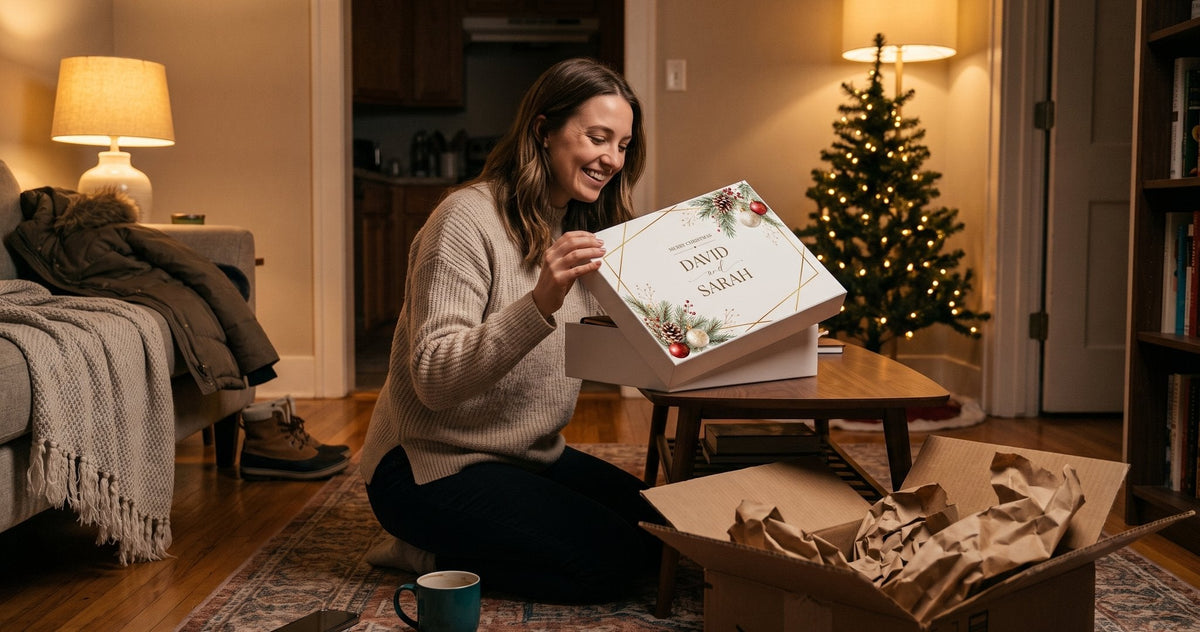
The trace is easy to put back: the recipient's name printed on the lid, a card chosen for that person rather than the season, a note in your own words, an arrival date tuned to their December.
The mechanics: flat $11.99 shipping, charged per destination, within the 50 states only. Boxes ship within 1–2 business days, and most orders arrive 5 to 9 business days after checkout. Several addresses means several shipments, each with its own name on the lid.
"It made her feel special and connected during Christmas receiving something so beautiful and personalized."
Others note the box "arrived in excellent condition and looks just like the photos" — the transit, in other words, is our half of the job.

What to write on the card
Our card archive settles the first question: senders choose "Merry Christmas" about four times as often as "Happy Holidays," and roughly seven in ten write their own message rather than leave it blank.
Keep it short — three sentences are plenty. A long letter about how hard the year has been without them turns the gift into an emotional debt the recipient has to service.
The most recognizable intonation in what our customers write: they name the distance out loud and never apologize for it. One shared memory or an inside joke lands harder than general pride — and write it by hand, the slant and pressure of the pen carry the hand itself.
- "No matter the miles between us, your place in my world never changes."
- "We're sending hugs and well wishes from long distance but in spirit we're holding you close."
- "Wishing you a peaceful, joyful holiday season with plenty of rest. Hoping the New Year brings us all back together soon."
Take these as samples of tone, not lines to copy. If this is the family's first Christmas after a loss, the card carries more weight than anything under it; we wrote separately about Christmas gifts for someone grieving.
A ready-made box or one you pack yourself
Packing it yourself wins wherever the box holds what only your house has: food from the hometown bakery, photographs, a child's drawing, a book with your notes in the margins.
The effort is worth something measurable: in a Vienna lab experiment, shoppers paid about 17% more for a bar of soap labeled "handmade" than for an identical machine-made one — paying for the care they read into it, not the quality. It holds only while the thing works: a candle that won't light produces embarrassment, not warmth.
A ready-made box wins on logistics: packed for transit in our studio, it ships within 1–2 business days, needs no second leg of postage, and doesn't eat a week of your December.
We make the ready-made kind. If the heart of the gift is something only you own, pack it yourself and start early. The middle path is honest too: the box comes to you, you tuck in your own things and send it onward. That costs a week, planned for in November.
Before Christmas or on Christmas morning
The early option lands the box ten to fourteen days ahead: homesickness peaks in the weeks before the holiday, not on the day itself, and a blanket that arrives in mid-December works every evening of the month instead of one.
The synchronized option lands early but stays sealed: a note that says "do not open until Christmas morning," and a video call where you unwrap together.
What decides is the person: will they spend most of December alone, and do your households share a free hour on the 25th? If December is the hard part, ship early; if the morning is the point, keep it sealed. Either way, the Christmas gift boxes on our shelf are packed for the truck ride and personalized before they leave.
Questions people ask
When should I send a Christmas care package so it arrives on time?
Count backward from the day it should arrive: boxes ship within 1–2 business days and travel 5 to 9, so order about two weeks ahead. Carrier ground deadlines cluster in mid-December; freight professionals add 7 to 10 days on top. Alaska and Hawaii need three to four more.
What should I put in a care package that has to travel across the country?
Things that don't leak, melt, or need batteries: a soft blanket, a ceramic mug, cocoa or holiday tea, a candle, chocolate, warm socks, a tree ornament. Bag anything scented and keep it away from food, or the cookies arrive tasting of soap. A handwritten card is the one non-negotiable item.
Is it better to send a ready-made gift box or pack one myself?
Pack it yourself when the gift is something only you own — hometown food, photographs, an annotated book. Choose a ready-made box when timing and transit survival decide: it's packed for the truck and ships within 1–2 business days. We make the ready-made kind; for irreplaceable things, build your own.
Should the box arrive before Christmas or on Christmas Day?
Earlier, if they're spending December mostly alone — missing home weighs heaviest in the weeks before the holiday, not on the day. If your households share a free hour, have the box arrive early with a "do not open until Christmas morning" note and unwrap it together on a video call.
From this guide
The boxes we'd send.
Each of these follows the five-thing rule.

Nutcracker Cocoa & Cinnamon Box
$61.00
Cocoa & Cinnamon Journal Box
$50.00
Jingle & Journal Winter Box
$50.00Keep reading
 ChristmasOccasions
Christmas Gifts for Your Boss: Why the Team Gift Works
A gift from one employee to the boss isn't expected, but a gift from the team is. How to pool, choose and... OccasionsThanksgiving
Thanksgiving Host Gifts: What to Send Before or After Dinner
A host gift thanks the table without adding to the day's work. What to send, when to order for dinner on November... ChristmasOccasions
When to Order Christmas Gifts So They Arrive in Time
Order by Friday, December 11, 2026 and even the slow end of our 5 to 9 business day window lands before Christmas....The newsletter
The next occasion is already on the calendar.
One email a month — a guide, an idea, and the shipping dates that matter.