
Christmas Gift Box Ideas: A Guide to Sending One That Lands
What goes in a Christmas gift box, what to spend on each person on your list, and the dates to order by so it arrives before Christmas Eve.
The short answer
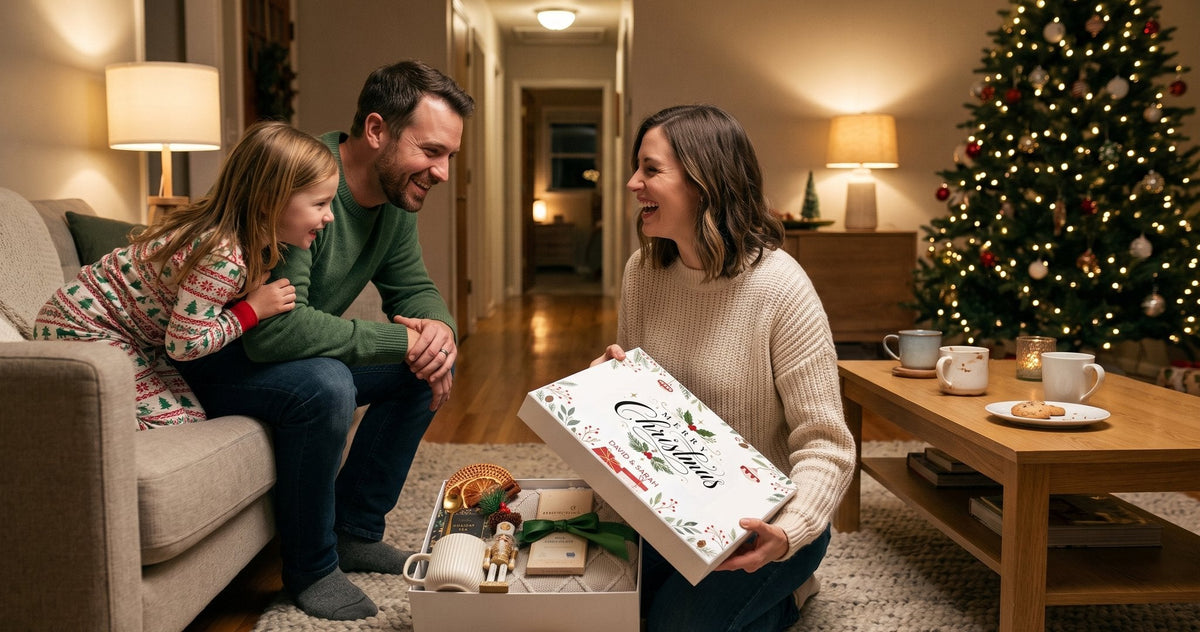
One curated set packed in a printed lid box: a blanket, a mug, cocoa or holiday tea, a candle, a small ornament, and a card written in your own words. Etiquette puts a coworker's gift at $20–60 and a teacher's under $25. Nikimoon ships in 1–2 business days and delivery takes 5–9 — order by December 12 to be comfortable.
What actually goes inside a Christmas gift box
This is a guide to the filled gift box you send to someone — not to building and decorating an empty box yourself. The same search covers both, so it's worth saying plainly which one you're reading: everything below is about what goes inside, who it suits, what it costs, and how it arrives on time.
Across the 26 boxes on our Christmas shelf, the same core repeats, and it repeats because it works:
-
A blanket
The anchor of the box — the thing that gets used the same evening it's unwrapped, and the reason a winter box feels like a gesture rather than a token.
-
A ceramic mug
It pairs with whatever is warm in the box, and it stays on a desk or a shelf long after the cocoa is gone.
-
Cocoa or holiday tea
Something to actually drink that week — spiced, seasonal, and finished before New Year's rather than pushed to the back of a cupboard.
-
A candle
Scent does more work than any decoration; it turns opening the box into the start of an evening.
-
A wooden nutcracker or ornament
One small object that goes straight onto the tree or the mantel — and comes back out every December after.
Around that core sit the small things — chocolate, a cinnamon stick, a slice of dried orange — and over all of it, the printed lid with the recipient's name. The lid is what turns a shipping carton into a gift: it's the first thing they see, before any single item.
What holds a set like this together is one quiet rule: everything in it is built for a single evening, and meant to be used within the week — not admired, stored, and forgotten.
Our own orders bear this out. The most-sent Christmas box of our year is the winter cozy set with a blanket and a mug, and it alone accounts for roughly two fifths of all our Christmas shipments.
In the studies known as the Presenter's Paradox (Weaver, Garcia & Schwarz, 2012), givers assumed a small, inexpensive extra made a bundle better — while recipients quietly averaged everything in it, so the add-on dragged the whole gift down. Fewer, better things beat a fuller box.
Who you're sending it to changes the box
The same set of items reads differently depending on the relationship, which is why most of the guides in our Journal start with the recipient rather than the product. Think in roles, not personality types: a coworker and a manager, a teacher and a daycare provider, a nanny, a neighbor, parents and grandparents. Each role carries its own line of what's fitting.
For work, etiquette draws that line clearly. The Emily Post Institute puts an individual coworker gift at $20–60 and a group exchange like Secret Santa under $10 — and advises against gifting up the ladder at all, unless the whole team chips in voluntarily for a shared gift.
School and service roles have their own boundaries: a teacher's gift should stay under $25 and never be cash, daycare staff typically receive $25–75, and a USPS mail carrier may only accept a non-cash gift worth $20 or less.
If it feels odd to send a curated box to a boss or a client, our own orders say otherwise. Notes about managers, coworkers, teachers, nannies and clients run through our Christmas season in a steady stream, right alongside the family ones — these roles aren't the edge of the season, they're its middle.
“This was a great gift for my boss! She loved it and it's really cute items in a cute box for a good price. Especially if you're not sure what to give to coworkers or managers.”

One box for a whole household
When the gift is for a couple or a family rather than one person, the logic flips from personal to shareable: one blanket generous enough for two, two mugs instead of one, tea and chocolate meant to be passed around. Nothing in the box should belong to somebody in particular.
On our shelf this is its own line — sets built around two mugs and a shared throw — and in our Christmas orders, boxes for couples and families are the second-largest group after the universal cozy set.
A shared box also solves a quieter problem: what one household does with several small separate gifts. A single box opened together reads as an event — cocoa poured, blanket unfolded, ornament hung. The same money spread across individual trinkets reads as an errand somebody completed.
“Gave to all my siblings and they loved it! Said the packaging was great.”
Which box specifically suits which household is a bigger question than this section — here, the principle is enough: choose the set no one in the house has to claim alone.
How much to spend without guessing
The season as a whole has a known price tag. In the National Retail Federation's 2025 holiday survey, shoppers planned to spend an average of $890.49 on the holidays, $627.93 of it on gifts for family and friends. One curated box sits comfortably inside that math.
For work relationships the frame is narrower: $20–60 for an individual coworker gift, under $10 where the office runs a group exchange, and about $25 per person when a manager gives down to the team.
Corporate buyers meet one more number. The IRS caps the deduction for business gifts at $25 per recipient per year (IRC §274(b), Publication 463) — a threshold set in 1962 and never adjusted since. It's a bookkeeping ceiling for the giver, not a verdict on what's appropriate to spend.
What people actually spend runs below what etiquette recommends. Bankrate's 2024 survey found median holiday gifts of $25 for a teacher and $20 for a mail carrier, and some shoppers are trimming budgets outright this year. If that's you, take the permission: a smaller, considered box lands better than a stretched one.
Whatever the number, the same averaging rule decides where it goes — into one genuinely good item rather than into more items. A box with one beautiful blanket beats the same box padded with fillers.
When to order so it arrives before Christmas
Start from the calendar. Christmas 2026 falls on a Friday, which makes Christmas Eve — Thursday, December 24 — the last day a package can arrive and still be a Christmas gift. Our timeline is fixed: boxes ship within 1–2 business days, personalization included, and most orders arrive 5 to 9 business days after checkout. Door to door, that's 5 to 9 business days — so the hard deadline for ordering is December 13, and the comfortable window is December 10–12.
The carriers close their own gates around the same dates. For 2026, USPS lists December 16 as the send-by date for Ground Advantage, while UPS Ground and FedEx Ground/Home Delivery both cut off on December 13. Air services stretch to December 22 — at air prices.
Our own season tells the same story from the inside. Almost all of our Christmas orders come in between October and December, and roughly seven in ten land in December alone. The queue you'd be standing in is at its longest in mid-December — which is why ordering early buys calm rather than a better price. Shipping is a flat $11.99 per address, to the 50 states only.
| Situation | What's in the box | Order by |
|---|---|---|
| A coworker or manager | Mug, cocoa, chocolate, candle — office-safe, no alcohol | December 13; December 10–12 to be comfortable |
| A teacher | Tea, candle, ornament — under $25, never cash | December 13 |
| A daycare provider | The same warm set, sized up — $25–75 is the typical range | December 13 |
| A couple or a family | Shared blanket, two mugs, cocoa and chocolate for everyone | December 13 |
| Family far away | The full cozy set, sturdy contents, a longer card | December 10–12 — earlier is kinder |
| A team or client list | Identical sets, neutral lid, one card text | Early December — multi-address orders deserve slack |

What to write on the card
About four in five of our senders choose “Merry Christmas” for the lid; the rest go with a neutral “Happy Holidays.” For a mixed work list, etiquette sides with the minority — a neutral greeting never has to be apologized for.
The card itself is not optional in practice. The overwhelming majority of our Christmas boxes leave with a personal note rather than a blank card — writing something is the norm, and two or three sentences is plenty. These went out on real cards this past season, names removed:
“Warmest Christmas wishes! We're grateful for all you do. Enjoy a wonderful holiday with those you love.”
“Wishing you a Merry Christmas! I'm so grateful for your continued trust and partnership over the years.”
“Thank you for being such a wonderful teacher. Your kindness, patience, and care mean so much to our family.”
“Even with the distance, you're still such a huge and steady part of my life. Merry Christmas to one of my favorite people on this earth!”
If writing one makes you hesitate, the hesitation itself is the misread. When researchers had people send notes of gratitude (Kumar & Epley, 2018), senders consistently underestimated how happy the notes made recipients and overestimated how awkward they would feel. The writer worries about choosing the right words; the reader registers warmth and sincerity, and very little else.
- Address people by name — and don't guess at a couple's status; two first names are safer than a title you might get wrong.
- Name the specific thing you're thankful for; one concrete sentence outworks three general ones.
- Sign it the way you talk. The card is your voice in the room when the box is opened.
“It made her feel special and connected during Christmas receiving something so beautiful and personalized.”

What to leave out
Alcohol is the first thing to reconsider. In a shared office box, etiquette guidance is to leave it out or send it separately — and to keep anything perishable shareable across the whole team rather than portioned for one desk.
Unmarked food is the second. Label what's gluten-free, vegan or kosher; an unlabeled treat isn't a treat to the person who can't risk it — it's the part of the gift that stays sealed.
The subtler trap is over-personalizing. Steffel and LeBoeuf (2014) found that givers asked to be “thoughtful” start hunting for a different, distinctive item for every person on the list — and end up passing over the thing everyone would actually have liked. The recipient loses to the giver's performance.
Recipients judge a gift mostly by how useful and wanted it is, and they mainly stop to weigh the giver's “thoughtfulness” when the gift misses (Zhang and Epley, 2012). Bet on the object they'll use, not on the cleverness of the choice.
And the wrapping is not an afterthought. For colleagues and acquaintances, neat packaging reads as a signal of how much the relationship is valued (Rixom, Mas & Rixom, 2020) — a carelessly assembled box costs more than it appears to save.
When the holiday lands in a year of loss
Some boxes on a list go to someone whose year held a funeral, and those boxes follow different rules. The tone comes down: no bright merriment on the lid, a quieter greeting, and warm contents that can be used the same evening — tea to brew tonight, a candle to light, a blanket to sit under. Comfort that asks nothing back.
On the card, name the person they lost instead of stepping around them. Remembering someone by name holds more than a page of careful avoidance ever will.
What to send, what to write, and what to skip in that year — the full guide is Christmas gifts for someone who lost a loved one.
Their first Christmas in a new home
A December box for new homeowners does double duty: it welcomes them to the house and furnishes their first holiday inside it. That changes the picks — the blanket and mugs begin the coziness in unfamiliar rooms, the candle gives the place its first winter scent, and the ornament may be the first decoration the new home owns.
One of our senders put it this way on the card: “As you celebrate your first holiday season in your new home, I hope it brings comfort, happiness, and plenty of time to enjoy the things and people you love most.”
Timing around the move, what suits an apartment versus a house, and what to write — all of it is in Christmas gifts for new homeowners.
Sending Christmas to family far away
When the box travels instead of you, it carries more weight — so the practical rules tighten. Order earlier than you would for someone across town, favor sturdy contents over fragile ones, and let the card run longer: for a parent several states away, the note is half the gift.
Standard carrier services include loss and damage coverage up to $100 by default, and requiring a signature on a holiday package usually hurts more than it helps — one missed delivery attempt can push the box past December 25.
Distance-proof contents, the dates, and what long-distance senders actually write — the complete guide is Christmas care package for family far away.
Boxes for a team or a client list
An order for a whole team runs on different mechanics: one identical set for every name, a neutral greeting on the lid, a single card text, and shipping to as many separate addresses as the list holds. Consistency is the point — nobody compares boxes, because there is nothing to compare.
Bulk pricing starts at 5 boxes, a single order can run up to 2,000, shipping is a flat $11.99 per address, and net-30 terms are available for approved corporate accounts. Our studio designs the lids, prints the names, and packs and ships every address on the same 1–2 business day timeline.
“Ordered 4 of these this year for clients and each one was personalized and special for their family. All of them absolutely loved their gift packages.”
Volume tiers, invoicing, and how the ordering process works step by step are laid out in Corporate Christmas gifts for employees and clients.
When Christmas isn't the holiday they keep
A thoughtful list accounts for the people on it who don't celebrate Christmas at all. The fix is simple: a neutral greeting on the lid and contents with no Christmas symbols — the blanket, the mug, the candle and the tea carry all of the warmth with none of the tree.
Our lid data hints at who is already doing this: the neutral greeting is chosen by a clear minority of senders, and that minority looks a lot like work lists with mixed recipients on them.
If someone on your list keeps Hanukkah, there's a dedicated guide to what to send across the eight nights: Hanukkah gift box ideas.
Questions people ask
How far in advance should I order a Christmas gift box?
Order by December 13 at the latest; December 10–12 is the comfortable window. The math: boxes ship within 1–2 business days and arrive 5 to 9 business days after checkout, and the last day a gift can land is Christmas Eve — Thursday, December 24, 2026. Carrier ground deadlines fall on the same dates: UPS Ground and FedEx Ground both cut off December 13.
How much should I spend on a Christmas gift box for a coworker?
Etiquette puts an individual coworker gift at $20–60, a group exchange like Secret Santa under $10, and a teacher's gift under $25 — never cash. If you're buying for a corporate list, the IRS deduction cap of $25 per recipient per year (IRC §274(b)) is a bookkeeping threshold for the giver, not a measure of what's appropriate.
Can I send Christmas gift boxes to several addresses at once?
Yes — shipping is a flat $11.99 per address, anywhere in the 50 states. Bulk pricing starts at 5 boxes, and a single order can run up to 2,000. Net-30 terms are available for approved corporate accounts. For a team or client list, one identical set with a neutral lid and a single card text keeps the whole order simple.
What should I write on the gift box card?
Two or three sentences are enough: thank them for something specific, wish them well for the season, and sign it in your own voice. About four in five senders choose “Merry Christmas”; the rest write “Happy Holidays,” which suits mixed work lists better. One real card, name removed: “Warmest Christmas wishes! We're grateful for all you do.”
From this guide
The boxes we'd send.
Each of these follows the five-thing rule.

Nutcracker Cocoa & Cinnamon Box
$61.00
Cocoa & Cinnamon Journal Box
$50.00
Jingle & Journal Winter Box
$50.00Keep reading
 BirthdayGift Guides
7 Long Distance Birthday Gift Ideas That Arrive on the Day
Seven birthday boxes that travel well, how to count back from the date so they arrive on time, and what to write... ChristmasOccasions
Christmas Gifts for Your Boss: Why the Team Gift Works
A gift from one employee to the boss isn't expected, but a gift from the team is. How to pool, choose and... ChristmasOccasions
When to Order Christmas Gifts So They Arrive in Time
Order by Friday, December 11, 2026 and even the slow end of our 5 to 9 business day window lands before Christmas....The newsletter
The next occasion is already on the calendar.
One email a month — a guide, an idea, and the shipping dates that matter.