
Hanukkah Gift Box Ideas: What to Send for Eight Nights
Sending a Hanukkah gift box to a house you will not be in: what goes inside, what stays out, what to write on the card, and the order-by date for 2026.
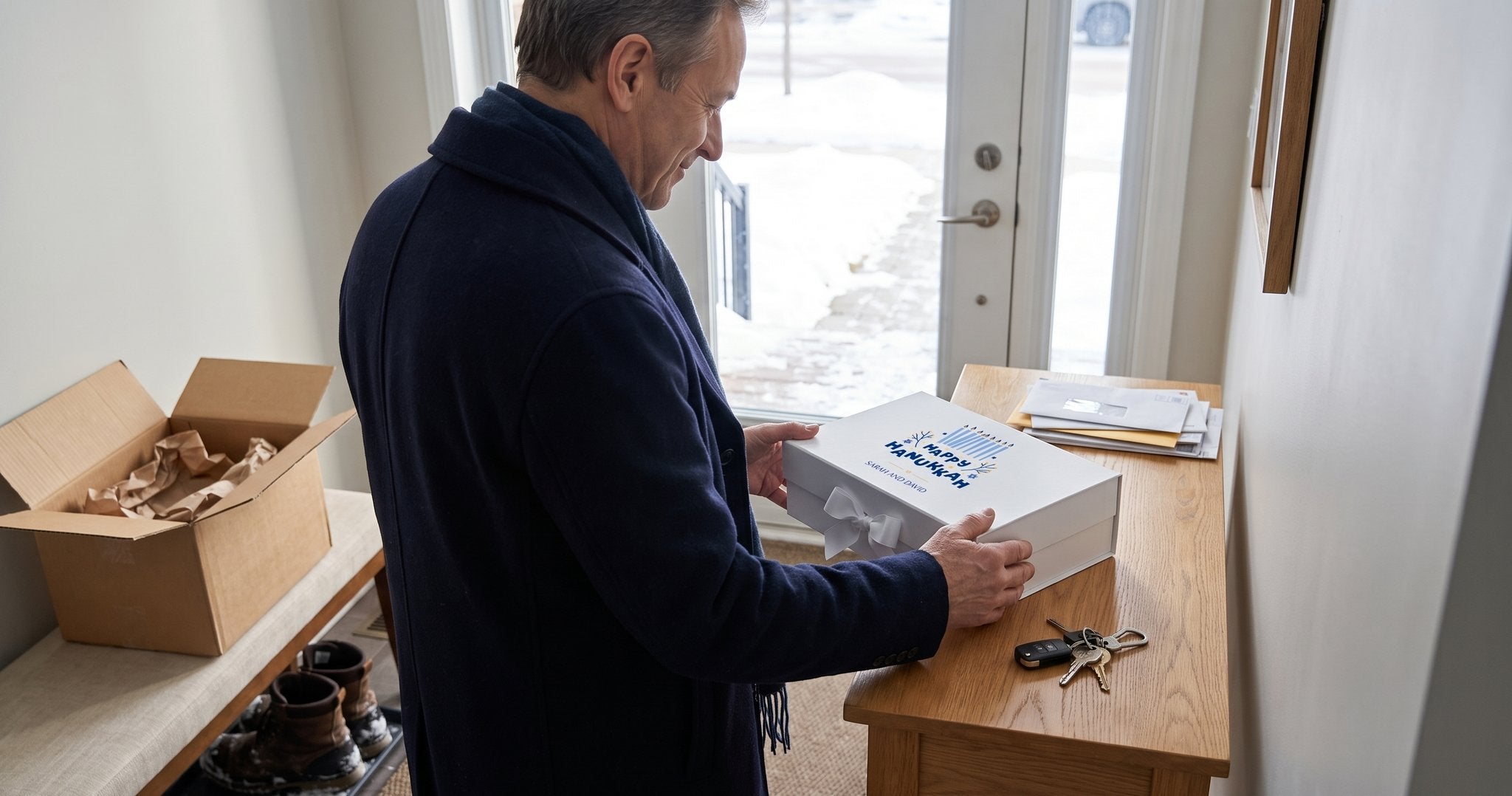
The short answer
For a house you will not be in, Hanukkah gift ideas start with one box: it arrives before the first candle and stays in use all week — a soft blanket, a mug or two, a handful of gold-foil chocolate coins for the dreidel game. Leave the menorah out; most families already have one they love. Hanukkah 2026 begins at sundown on Friday, December 4, so order by November 20.
What do you send for Hanukkah?
One box, built to be used rather than displayed: a blanket for the couch where the candles are watched, a mug or two for the evenings that follow, chocolate coins for the table. It is not a substitute for eight presents; it is one gift that lands on the first night and is still in use on the eighth.
Most Hanukkah gift ideas online are written for the parent running all eight nights. You are on the outside of that house: a relative in another state, a friend, a colleague, someone who does not light candles and would rather not get it wrong. The first candle of 2026 is lit at sundown on Friday, December 4, and the eight nights run until nightfall on Saturday, December 12.
Gift-giving at Hanukkah is an American habit, not an ancient rule; it grew up through the nineteenth and twentieth centuries alongside a commercial Christmas. So the holiday has no required present, and between adults one considered gift for the whole festival is the norm. That leaves you free to send something good — you will find more gift guides in the Nikimoon Journal, all starting from the same place.
When does Hanukkah start, and when should the box arrive?
Hanukkah 2026 begins at sundown on Friday, December 4, and the box should be in the house before that evening. The date moves because the holiday follows the Hebrew calendar — it always starts on the 25th of Kislev, and a Hebrew year runs about eleven days short of a solar one — so the first candle wanders between late November and late December.
This year it lands early: the eighth candle is lit on Friday, December 11, and the holiday ends at nightfall on Saturday, December 12, almost two weeks before Christmas. Our own order records show the trap. Roughly three in four of our Hanukkah orders were placed in December, when that season's first candle was on December 14. In 2026 the same timing misses the first night by more than a week — and the Hanukkah shipping cutoffs circulating for 2026, December 8 to 15, are no help: the earliest is four days after the first candle, the latest after the holiday ends.
Count back from December 4 with our own timings (ships within 1–2 business days, arrives 5 to 9 business days after checkout), remembering that Thanksgiving, Thursday, November 26, removes a working day. Order by Friday, November 20, and the box is there before the first candle even at the slow end of the window. Order on Black Friday, November 27, or later, and it lands between the first day and the seventh night.
Arrive early rather than on the day: in 2026 both the first and the eighth evening fall on a Friday, the eve of Shabbat, when an observant home does not sign for parcels or tear open packaging after sundown. A box that waits, closed, until Friday is what the household expects.
| Order by | Where the box lands in the eight nights |
|---|---|
| Friday, November 20 | Before the first candle, even at the slow end of our window |
| Thanksgiving week, through Wednesday, November 25 | Usually before night one; in time for the middle nights either way |
| Black Friday, November 27, or later | Inside the eight nights, not ahead of them |
| The Hanukkah cutoffs circulating for 2026, December 8–15 | Too late: the last falls after the holiday ends on December 12 |
What goes inside a Hanukkah gift box?
A warm layer, something to drink from, something sweet in gold foil. The blanket stays on the couch where the candles are watched; the mugs come out every evening after lighting; the coins are gone within a few nights, which is the point. Nothing here is opened once and put away, and nothing depends on how the house prays.
Our own order records back the mix: every box that actually went out for this holiday last season carried a knit blanket and a mug. The shelf has grown since — candles, gold-foil chocolate coins, mugs in pairs, a journal with a pen.
Gelt is Yiddish for money, and in Eastern Europe in the 1600s and 1700s it was real money — small coins for teachers who could not charge for teaching, later for the children who carried them. The gold-foil chocolate coin is an American invention of the 1920s, and today it is above all the stake in the dreidel game, so a box needs a handful, not one.
The worry underneath is whether a plain good blanket is a dodge. Jewish writers and cultural commentators say the opposite: a neutral-colored blanket, handmade ceramics and chocolate worth eating land more warmly than menorah-printed anything, because nothing about them can be wrong. Hanukkah gift baskets lean on food, which drags the household's kitchen rules into the gift; textiles and ceramics carry no such rules.
That is the shape of our Hanukkah gift boxes. The Hanukkah Chocolate Coins Box — a soft blanket, chocolate coins, cozy socks — is best for one person. The Hanukkah Coins & Candles Duo Box — coins, Hanukkah candles, two ceramic mugs — is built for a couple who lights together. The Gilt Coins & Journal Box swaps the blanket for a journal with a pen, a mug and a coaster, for the friend at a distance. None is sold as kosher-certified; if the house keeps kosher, treat the coins as any food gift and check first.

What not to put in a Hanukkah gift box
-
Christmas, repainted
Blue-and-silver tinsel, a mug that says Oy to the world, a Hanukkah gnome, a tree renamed a Hanukkah bush. Each is a Christmas object with the colors swapped, and reads that way: someone else's holiday in a costume. The gnome's pointed hat, besides, has a medieval history no gift should carry.
-
A menorah chosen blind
Most families already own one, often the one their grandparents lit. The object also has rules — eight lights in a straight row at one height, the helper candle set apart — and a seven-branched candelabra is a Temple symbol, not a Hanukkah menorah. One that fails the rules is quietly put away.
-
Candles meant to solve something
A box of Hanukkah candles is a fair extra — a menorah burns 44 over the eight nights — but not the gift, and not a fix for Friday. A standard candle is about 3/8 inch across and burns around 30 minutes; a menorah with different cups will not hold it, and on Friday the lights go in before sundown and must last far longer.
-
Food with no real mark
A lone letter K on a package guarantees nothing, since anyone can print one, and kosher-style is not kosher. A kosher home looks for the mark of a recognized agency: OU, OK, Star-K or Kof-K. If you know nothing about how the house eats, skip food altogether.
-
Fried things by mail
Latkes and sufganiyot are eaten hot, minutes out of the oil, and last hours, not days. To nod to the oil at the heart of the holiday, send the oil — a good olive oil in dark glass — or a jar of proper jam for the doughnuts they will fry themselves.
The commonest mistake sits outside the box: Christmas wrapping paper on a Hanukkah gift. Snowmen count. Families who celebrate both holidays notice, and it reads as erasure. Plain deep blue, silver or white is safe.
What do you write on a Hanukkah card?
Short, sincere and in English. Happy Hanukkah is right for everyone from a close friend to a client, and beats a phonetic attempt at Hebrew unless you speak it. The card on these boxes says exactly that; the notes underneath are where the warmth lives.
About half the notes in our own records are written to two people or to a whole household. If the box is going to a home, a note to a single name lands slightly off; one to both of them, or to the family, lands right.
A noticeable share of the notes thank someone for a working year — a colleague, a client, a teacher, a cantor; Hanukkah turns out to be a natural moment for thanks.
Happy Hanukkah to two people who make our lives brighter all year long. May your candles burn bright, your latkes be crispy, and your days be filled with laughter, love, and a little extra magic.
Wishing you a warm, peaceful Festival of Lights filled with joy, good health, and lots of cozy moments.
I am so lucky to have had this opportunity to work with you this year. Happy Hanukkah and see you in the awesome new year.
The first of those does what the good notes in our records do: it names what will happen in the house — candles, latkes, evenings — rather than the gift. Write toward the room, not the box.
Hanukkah and Chanukah are both legitimate transliterations of one Hebrew word whose first letter has no English sound: Hanukkah is the everyday standard, Chanukah the older form, common in more traditional homes and in a few of our own notes. The only real error has a double n. Pick one and keep it for the whole card.
Who are you sending it to?
A couple, most often. More than half of the shelf is built for two — two mugs, two of what gets used — and our own notes agree: the salutations name both. That is a sender's decision, not a stock decision; a box for two says you are thinking of the evening they share.
A house with children, where Hanukkah gifts for the family are already bought and rationed by the parents. Do not compete with that pile from another state; the opening is the adults' side of the evening — a blanket and two mugs for after bedtime, the gift that house gets from no one else.
A colleague, a client, a teacher. Keep the scale where the relationship sits, and send nothing that obliges a gift back. An employee does not give a personal gift to a manager; a group gift with every name on the card is how a team thanks upward.
A home that celebrates both holidays. Keep them separate: nothing that blends the two, no Christmas paper on the Hanukkah gift. One of our own notes went to such a house — “Sending you this basket full of the comforts of the season, along with my love and wishes for a joyful Hanukkah and Christmas.” — and it names both rather than folding one into the other.
And the house where this is the first December without someone. One of our notes says it better than we could: “Peace be upon you and may light guide you through the darkness, one day at a time.” The box matters less there than the note, and what to send when someone is facing their first holiday season after a loss has rules of its own.
How one box works across eight nights
The first and the eighth night carry the weight in almost every home: the first has its own blessing for reaching the season and usually the main gift, the eighth the picture everyone takes with every candle lit. One box, sent to arrive before December 4, belongs to the first night and stays on the couch for the other seven.
Several separate things for a house with children should be labeled by night or by name; otherwise the parents fold them into the pile and hand them out as they see fit. One box addressed to the adults skips the sorting.
Arriving early is nothing to apologize for: the household expects a box to turn up ahead of the holiday and sit closed until the first candle.
Our terms: we ship only within the United States, all 50 states; shipping is a flat $11.99, charged per destination; boxes ship within 1–2 business days, including the name printed on the lid; most orders arrive 5 to 9 business days after checkout.

Questions people ask
Do you give a gift on every night of Hanukkah?
No single rule says so. A present every night is mostly a habit of homes with small children. Adults usually exchange one considered gift for the whole holiday, often on the first or the last night, and many families give some evenings to books, cooking or charity instead.
Can you send a Hanukkah gift if you are not Jewish?
Yes, and it is welcomed, as long as the gift fits the relationship, does not copy a Christmas template in blue, and asks for nothing back. The safe version is a good secular thing — a blanket, ceramics, chocolate worth eating — with a short, sincere note in English.
Hanukkah or Chanukah — which spelling should you use?
Either. Both are transliterations of the same Hebrew word, whose first letter has no English sound. Hanukkah is today's standard; Chanukah is closer to the traditional spelling and more common in traditional homes. The only real mistake has a double n. Choose one and keep it across the card.
Does a Hanukkah gift box need to be kosher?
It depends on the house, and guessing is the mistake. If the box holds food, look for the mark of a recognized agency: OU, OK, Star-K or Kof-K. A lone K guarantees nothing, and kosher-style is not kosher. If you know nothing about the household, send something that is not food.
What is Hanukkah gelt?
Gelt is Yiddish for money. In Eastern Europe the coins were real, given to teachers and then to children; the gold-foil chocolate coin is an American invention from the 1920s. Today gelt is mostly the stake in the dreidel game, so a box wants a handful rather than one coin.
From this guide
The boxes we'd send.
Each of these follows the five-thing rule.

Hanukkah Chocolate Coins Box
$60.00
Hanukkah Coins & Candles Duo Box
$62.00
Gilt Coins & Journal Box
$39.00Keep reading
 ChristmasOccasions
Christmas Gifts for Your Boss: Why the Team Gift Works
A gift from one employee to the boss isn't expected, but a gift from the team is. How to pool, choose and... OccasionsThanksgiving
Thanksgiving Host Gifts: What to Send Before or After Dinner
A host gift thanks the table without adding to the day's work. What to send, when to order for dinner on November... ChristmasOccasions
When to Order Christmas Gifts So They Arrive in Time
Order by Friday, December 11, 2026 and even the slow end of our 5 to 9 business day window lands before Christmas....The newsletter
The next occasion is already on the calendar.
One email a month — a guide, an idea, and the shipping dates that matter.