
Sympathy Gifts for the Loss of a Mother: What to Send
What to send someone who lost their mother, and when: the funeral week, the month after when it goes quiet, her first birthday without her. From our orders
The short answer
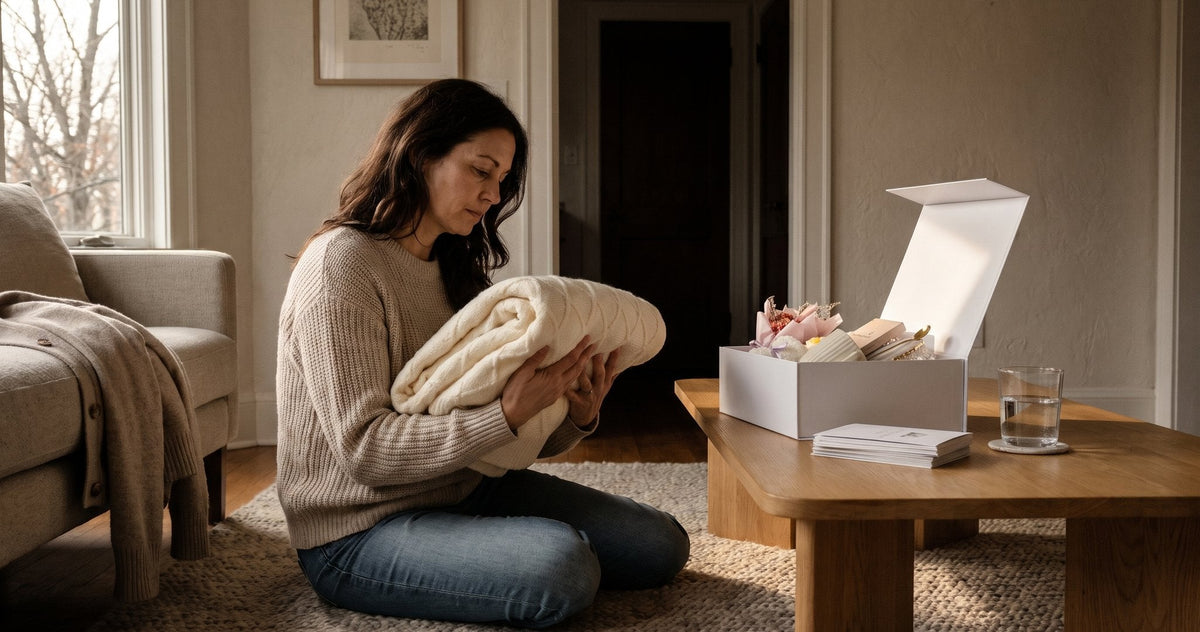
Send something that can wait on a table: a soft blanket, a hand-poured candle, a dried bouquet that needs no vase, herbal tea or cocoa. The lid carries the recipient's name, the card inside carries your words. The funeral week is already full, so a box that arrives a month later often lands in a quieter, emptier moment. Order about two weeks ahead.
The first week, when the house is already full
Send the thing that asks nothing of them. The house is full of people, food and arrangements, and the person who lost their mother is making decisions on no sleep. A gift that needs a vase, fridge space or a thank-you note joins the list. A box that waits on the table, closed until they are ready, does not.
A dried bouquet does what cut flowers cannot: it is still standing when the sprays from the service have wilted. The sympathy boxes from our studio are built on that idea: a soft 50×70 blanket, a hand-poured candle, a dried bouquet or a succulent in a ceramic pot, herbal tea or cocoa. The Blanket & Bouquet Comfort Set pairs the blanket with dried flowers and the candle, the Succulent & Soft Blanket Box swaps in a succulent, and the Honey & Herbal Tea Comfort Box builds around tea and honey. Across the sympathy shelf, a blanket is in roughly seven boxes out of ten, a candle in two out of three, dried flowers or a succulent in about half.
The name on the lid is the recipient's, the person who lost their mother, not the mother's. The guide to sympathy gifts after any loss covers the wider ground, and a care package for a grieving friend, whoever they have lost, is a guide of its own. The box is not there to make anything better. It says you are there, and that is all it says.
A month later, when everyone else has gone quiet
Support arrives as a wave: meals on the porch, cards, calls, people in the kitchen. Then the service is over, everyone goes back to their own week, and the person is alone with it for the first time. A box sent three or four weeks after the funeral lands in that quiet, not in the flood.
It is not too late: a month on, half a year on, the reason is still there. The box can be the same soft set; what changes is the note, which now asks for nothing back:
Thinking of you and holding you in so much love. No need to respond — we just wanted you to feel wrapped in care.
Another note sets the tone of a late gift: "Sending you a whole box of hugs and comfort. I know this season has been a lot to carry, and I just wanted you to have something soft, kind, and just for you." If you would rather put the package together from your own things, the care package guide walks through what goes in.

Her birthday, Mother's Day, the first holidays
The first dates without her are known in advance, which is why a gift on one of them lands. Her birthday, the first Mother's Day, the first Thanksgiving or Christmas with her chair empty: your friend has been thinking about the date for weeks, and a box arriving that week says you were thinking about it too. The date is the explanation; the card needs none.
What changes is the wording, not the contents: "Happy birthday" does not fit a day the person is dreading, so say instead that you know it is hard. A note from our orders, for a first birthday without a mother: "Wishing this birthday wasn't filled with so many emotions. Sending BIG hugs!"
No seasonal box is needed; the same soft set as in the first week is right for a birthday in June and a Thanksgiving in November. Faith stays off the card unless it belongs to both of you: when a prayer appears in our orders, the giver wrote it, and that is their choice, not our suggestion.
One box from a group of people
A box from several people is an ordinary thing in our sympathy orders: notes signed by a team, a class, an office or a company sit alongside the personal ones. From coworkers:
Please know that everyone here is holding you close in our thoughts during this incredibly difficult time. We are so sorry for the loss of your mother. We hope this small gesture brings a bit of comfort and serves as a reminder that you are supported and cared for by your work family.
Sign it either way, every name written out or the team named in one line; both live in our orders. One box for a brother and sister works too, and the card then speaks to both: "I was sorry to hear about the loss of your mother. No matter the age, it is still difficult. Wishing you both peace, comfort, and brighter days."
A shared box wants contents for two: the Blanket & Cocoa Duo Box holds one blanket, two ceramic mugs, a bar of chocolate, herbal tea and a candle. A coworker's box goes to a home address, so anything too intimate comes out: a blanket, a candle and warm socks, as in the Cozy Comfort Wellness Box, where bath salts would be a step too far.
What not to send, and what not to say
Leave out anything that asks for work, space or a decision. The gifts that fail that test are the ones people reach for first.
-
Cut flowers
They need a vase, water and a place to stand, and the house already has more than it can hold.
-
Anything perishable
Fruit, baked goods and meals need fridge space and a decision about when to eat them, both in short supply this week.
-
A living plant
Anything that has to be watered is a responsibility handed to someone with no room for one; a succulent in its pot is the exception.
-
Anything with her name or photo on it
A memorial piece is the family's decision, not a gesture from outside. Unless they asked for one, keep her name off the gift; the lid carries your friend's.
-
Strong scents
A heavy perfume has too much to do in a house that has just held a funeral. One hand-poured candle, lit when they choose, is enough.
On the card, leave out the lines that try to fix it: that it was for the best, that time will soften this, that she is somewhere better now, that your friend has to stay strong. Do not ask what happened, or how. From our orders: "There are no perfect words for what you're walking through — just know that you are surrounded by people who are holding you, even on the days you can't feel it." Another gives permission instead of comfort: "There is no rule book on grief; so it's okay to be pissed, sad, hurt, but thankful all at the same time." A short line works as well as a long one; on these cards a full paragraph and three words sit side by side. No gift has to repair anything, and none of ours is meant to.
The words on the card and the name on the lid
The lid and the card are separate fields at checkout, and both get filled in: the recipient's name is printed on the magnetic lid, your message on the card inside, word for word as you send it.
What people ask us to print is less formal than you might expect. "Sending hugs" and "thinking of you" run almost neck and neck and together cover roughly five givers out of six; "deepest sympathy" takes the rest. The most common condolence in our orders is not a formula but the plain fact of thinking about someone.
If you are stuck on the wording, the guide to what to write in a gift card walks through it line by line. One review: "Fast shipping and good communication - appreciated all the ways it could be personalized." No paper with a price ever goes inside the box, no receipt and no invoice; the recipient sees the name, the card and the contents.

Ordering so it lands when you mean it
Every box ships within 1–2 business days, personalization included, and spends 4 to 7 business days in transit, so most orders arrive 5 to 9 business days after checkout. Order about two weeks ahead and the box has the whole 5–9 business day window. Shipping is a flat $11.99 per destination, within the 50 states only; several addresses in one order are charged per address.
For a known date, her birthday or Mother's Day, count from arrival, not from shipping. For a team, bulk pricing starts at 5 boxes: 5–19 save 5%, 20–49 save 7%, 50 and up is priced individually, and a single order can run up to 2,000 boxes.
From the reviews on these orders: "This was a gift for a friend going through a difficult loss. It was a little box of sunshine and healing, giving her a spark of light in the dark." And from someone who sent one to an employee: "Sent as a bereavement gift. My employee was touched by it."
Questions people ask
What is an appropriate sympathy gift for someone who lost their mother?
Something soft that waits and asks for nothing: a blanket, a candle, dried flowers instead of cut ones, tea or cocoa, the recipient's name on the lid. Memorial items with her name or photo are the family's call.
Is it too late to send a sympathy gift a month after the funeral?
No. Three or four weeks after the funeral the wave of support breaks off, and a box then lands in the emptiest moment. Half a year on the reason is still there; a note that asks for no reply works best.
What do you write on a sympathy gift for the loss of a mother?
A short line with no explanation. "Thinking of you" and "sending hugs" are what people ask us for most often. Skip the lines that try to fix it; the gift card guide walks through the rest.
Can a group of friends or coworkers send one sympathy gift box together?
Yes, it happens in our orders all the time. Sign with every name or the team's name in one line; one box can be addressed to two people, a brother and a sister say. Bulk pricing starts at 5 boxes: 5–19 save 5%, 20–49 save 7%.
How long does a sympathy gift box take to arrive?
It ships within 1–2 business days and spends 4 to 7 in transit, arriving 5 to 9 business days after checkout. Shipping is a flat $11.99 per address, 50 states only. Order about two weeks ahead and the box has the whole 5–9 business day window.
From this guide
The boxes we'd send.
Each of these follows the five-thing rule.

Blanket & Bouquet Comfort Set
$62.00
Succulent & Soft Blanket Box
$62.00
Honey & Herbal Tea Comfort Box
$59.00Keep reading
 ChristmasOccasions
Christmas Gifts for Your Boss: Why the Team Gift Works
A gift from one employee to the boss isn't expected, but a gift from the team is. How to pool, choose and... OccasionsThanksgiving
Thanksgiving Host Gifts: What to Send Before or After Dinner
A host gift thanks the table without adding to the day's work. What to send, when to order for dinner on November... ChristmasOccasions
When to Order Christmas Gifts So They Arrive in Time
Order by Friday, December 11, 2026 and even the slow end of our 5 to 9 business day window lands before Christmas....The newsletter
The next occasion is already on the calendar.
One email a month — a guide, an idea, and the shipping dates that matter.