
Sympathy Gift Ideas: What to Send After a Loss
What to send when someone dies, what works instead of flowers, when to send it, and what people actually write on the card — from our own orders.
The short answer
The gifts that help after a loss ask nothing back: a soft blanket, a candle, tea or cocoa, something sweet, a potted succulent — things they can use tonight without cooking, calling or thanking anyone. A plant in a pot is still there when the bouquets are gone. Keep the card short and open. The first two weeks work, and a month on, when the phone has gone quiet.
What to send when someone dies
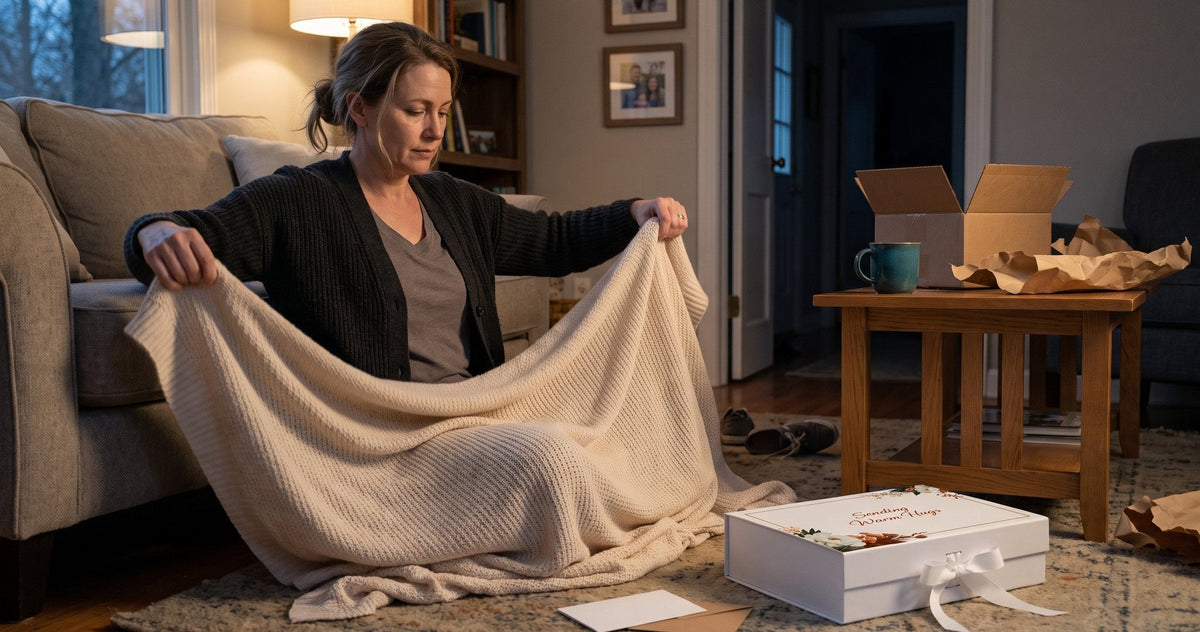
Send something they can use the same evening: a soft blanket for the sofa, a hand-poured candle for a room that has gone too quiet, tea, cocoa or honey for the kettle that will be on all week, something sweet, a plant in a pot for a windowsill. Each does its work without asking anything of the person who opens it.
That is the test for a sympathy gift: it should not create work. Nothing to cook, nothing to assemble, no call to return, no thank-you owed by the weekend. A gift that simply sits there, ready when they are, is the one that helps.
Food belongs on the list only when it needs no stove and no dishes: chocolate, shortbread, a jar of honey. There is probably already a row of casseroles in the fridge, each in a dish that has to go home.
Choose for the evening ahead of them rather than the year. If you are putting a box together yourself, our care package guide applies the same principle to other hard weeks: an illness, a move, a breakup.
What to send instead of flowers
Send something that will still be there in a month: a plant in a pot, a candle, tea or cocoa, food that needs no cooking, or a box that brings those together. Flowers are simply what everyone sends, on the same two days, and the house runs out of places to put them.
Bouquets need vases the house does not have and water changed by someone who has not slept, and by the end of the week they go out to the bin together.
Among the orders that leave our studio with a sympathy card, close to half go to the same box: the one built around a succulent in a ceramic pot. Nobody planned that; buyers found it. What stays in the house once the bouquets have gone is whatever needed no vase: a pot on the windowsill, a candle, a blanket on the sofa, a mug by the kettle, dried flowers. The box sits on our sympathy shelf.
This was a beautiful gift for my friend who lost her grandmother. I wanted to send something other than flowers and this had it all — a succulent, hand cream, blanket, chocolate, pretty mug, cute candle.
If the notice says donation in lieu of flowers, take it literally: give to the cause they named and send nothing to the service. The box can follow on its own, a week or two later, addressed to the one person in that family you actually know.

When to send a sympathy gift
The first week works, and so does the third; the choice is yours rather than a rule of etiquette. In the first days the house is full of people, food and phone calls, and a box joins the pile on the counter. Two or three weeks after the funeral the visitors have gone, the fridge is empty again, and the same box arrives into silence.
It is never too late. A month on, six months on, the first anniversary: these are the days when the person is remembering and almost nobody else is. If you are writing late, say so in one plain line and skip the apology.
Loss has no season: boxes with our sympathy cards go out in every month of the year, so the real question is how fast it can arrive. Personalized boxes ship within 1–2 business days, and most orders arrive 5 to 9 business days after checkout. Expect flat $11.99 shipping, charged per destination; every order ships only within the United States.
Send it to a home address, in the name of the person you know, not "the family of". In the first days mail goes to several addresses at once, and a parcel addressed to no one in particular is the one left in a hallway.
| Who you are to them | What to send | When to send it |
|---|---|---|
| A close friend | A blanket, a candle, a note that names the person they lost | Right away, or again a month on |
| A relative | A box to the home they are staying in now | The week after the funeral |
| A coworker | Tea, chocolate, a candle, a short card | Before they return to work, at home |
| A team, to one of your own | One shared box, one card, everyone's first names on it | In the first two weeks, to their home |
| A client or an acquaintance | A candle or a plant with a plain, brief card | Within a couple of weeks |
| A neighbor | Food that needs no cooking, left at the door with a note | Any day; the quiet weeks most |
What to write on the card
Keep it short and keep it open. When people choose a card for these boxes, roughly five in six pick a line that does not name what happened, sending hugs or thinking of you, and only about one in six picks the one that says sympathy outright. It leaves room for whatever they feel that day.
The notes people write in their own words follow the same instinct. About three in four never mention the death at all, and the typical message runs to around two dozen words. Short is normal here; a long note is not more caring.
A note as one buyer wrote it:
There are no perfect words for what you're walking through — just know that you are surrounded by people who are holding you, even on the days you can't feel it. We're here for you, whatever you may need. You are not doing this alone.
Another buyer sent this and nothing more: "I am so sorry for your loss. You and your family are in my thoughts. Sending hugs." Both land: one promises company and names nothing, the other names the loss and stops. Neither explains, advises or asks a question the reader would have to answer.
Cut anything that explains the death or puts grief on a schedule: everything happens for a reason, he is in a better place, it gets easier after the first year. Cut questions about how it happened. Each asks the reader to look after your feelings.
What fits is the name of the person who died, if you knew them, and one concrete thing you will do: I'll call on Sunday, dinner is coming Thursday. About one note in seven carries an offer like that, and it is the line people keep. For length and sign-off, see what to write in a gift card.
In a Nikimoon box the recipient's name is printed on the lid and your message goes on the card inside, exactly as you typed it; the card carries the sentence you spent the longest on.
What not to send
Leave out anything that hands a grieving person a job, a mood or a deadline. If the gift needs an answer, a shelf, a schedule or a smile, it will wait in a corner and quietly make them feel guilty.
-
Anything that needs a reply
Dishes to cook, serve and return; kits to assemble; gifts grand enough that a thank-you feels owed by Friday. Each is a task with your name on it, in the week when tasks are the last thing they can hold.
-
Anything cheerful
Balloons, a cheer up mug, a joke print, bright party wrapping. They ask the person to perform being fine, in front of you, before they are.
-
Anything with a timeline
Books about getting through grief in a month, planners, cards about new chapters. They set a deadline on someone else's loss, and the person notices the date long before the kindness.
-
Memorial pieces they did not ask for
A portrait on ceramic, an engraved plaque, jewelry that holds ashes. These choices belong to the one who is grieving, in their own time, not to the sender.
-
Anything medical or "for the nerves"
Supplements, calming teas sold as remedies, oils presented as treatment. A gift is not a prescription, and it should not suggest the person needs fixing. Tea is welcome when it is simply tea.
Ask what the gift will demand of them on a bad Tuesday, and send the thing that demands nothing.
Sending from a workplace or a group
A shared box from a team is the norm, not the fallback. Close to half the notes that come through with our sympathy boxes are written as we: a department, a team, a row of first names. One box, one card, sent to the person's home, reads as a group standing together.
A note that arrives in our orders again and again, nearly word for word, with only the person mourned changing:
Please know that everyone here is holding you close in our thoughts during this incredibly difficult time. We are so sorry for the loss of your father. We hope this small gesture brings a bit of comfort and serves as a reminder that you are supported and cared for by your work family.
It is signed by an organization and still sounds like people. One person collects the names, one writes the card, and one box goes to the home, not the office. Do not organize the collection anywhere the recipient can see it, and sign with names, not with the company.
From buyers who sent one this way: "My boss loved her gift from her team after the loss of her mom." And: "Sent as a bereavement gift. My employee was touched by it."

Different losses ask for different things
The same box does different work depending on who was lost, and the card should follow. A parent, a grandparent or a close friend is the loss we see most often in our orders; for what goes into the box itself, item by item, read the care package for a grieving friend.
A pregnancy loss or the death of a baby asks for different words: do not congratulate anything, do not look for reasons, do not promise a next time. The care package after a miscarriage is written for exactly this.
The death of a pet is a real loss and gets a real gift. Such orders are rare among ours, but the notes on them use the words people use for a person: "I hope that this gift can bring you some comfort during this difficult time. I'm sure he is watching over you from over the rainbow bridge."
Grief comes back on the calendar, and a box that arrives in the first December without someone is not a late sympathy gift but a different one, sent because you remembered. Christmas gifts for someone grieving covers that season.
If the person is recovering rather than mourning, you want the get-well box after surgery; that is a different kind of care again. And loss is not only death: after a breakup the gift says you are still somebody's, after a layoff that the job was never the whole of you. There is a care package after a breakup and one after job loss.
What's in a Nikimoon sympathy box
Nearly three in four boxes on the shelf are built around a 50x70 blanket. About two in three include a hand-poured candle, more than half something for the kettle, tea, cocoa, coffee or honey, and more than two in five add dried flowers. A few carry the succulent in a ceramic pot that close to half of our sympathy orders choose.
Almost all of the shelf is written for a woman. The exceptions: a box named for him as well, a box for two, a box with a pair of mugs. The name on the lid makes any of them his.
The name goes on the lid and your message on the card inside, which is why the card matters more than the choice of box. Every box ships within 1–2 business days, personalization included, and most orders arrive 5 to 9 business days after checkout, with flat $11.99 shipping, charged per destination; across 1,448 reviews our average rating is 4.93. The full shelf is at sympathy gift boxes: choose the one you would want on a bad evening, and let the card do the rest.
Questions people ask
What is an appropriate sympathy gift?
Something they can use the same evening and owe nothing for: a soft blanket, a candle, tea or cocoa, something sweet, a plant in a pot. Price is not what makes it appropriate; what matters is whether it asks anything back, whether cooking, a reply or a thank-you. If it asks nothing, it fits.
What can I send instead of flowers?
A plant in a pot, a candle, tea or cocoa, food that needs no cooking, or a box that brings them together. A plant is still on the windowsill after the bouquets are gone. If the family asked for a donation in lieu of flowers, give to that cause and send your gift later, personally, to the one person you know.
Is it too late to send a sympathy gift?
No. The quiet weeks after the funeral and the first anniversary are exactly when the cards have stopped coming. If you are writing late, say so in one line, still thinking of you, and skip the apology. Boxes ship within 1–2 business days, and most orders arrive 5 to 9 business days after checkout.
Should I send the gift to the family or to the person I know?
To the person you know, at their home address and in their name. If you know the whole family, send one box to the house where they are staying now. In the first days mail arrives at several addresses at once, and a parcel addressed to the family in general is the one left in a hallway.
From this guide
The boxes we'd send.
Each of these follows the five-thing rule.

Dried Bloom & Cocoa Blanket Box
$62.00
Cotton Scrubber Soak & Cocoa Box
$61.00
Pumpkin Cookie & Honey Mug Box
$66.00Keep reading
 EngagementGift Guides
Engagement Gift Ideas and Anniversary Gifts: Complete Guide
One gift for two people, not a present for the bride: what goes in a box for a couple, how it shifts... OccasionsSympathy
Care Package for a Friend Who Has Been Fired: What to Send
What to send a friend who just lost their job, what to write on the card, and when to send it, from... BirthdayGift Guides
Gift Box vs. Gift Basket: Which Says Thank You Better?
An open basket shows abundance to a room; a closed, lidded box carries your message to one person and survives the mail....The newsletter
The next occasion is already on the calendar.
One email a month — a guide, an idea, and the shipping dates that matter.